There is a reason why a folk song that is hundreds of years old can still make a listener cry. It is not the production quality. It is not the technical complexity. It is the honesty. The song contains something true — about love, or loss, or the beauty of a place, or the difficulty of being human — and that truth transcends time, language, and culture.
This is the fundamental principle of storytelling in music: the most powerful songs are always the most honest ones. And regional artists, by virtue of their specific relationship to language, place, and cultural memory, have a storytelling advantage that no amount of production budget can replicate.
What Makes a Story Resonate?
Before exploring the regional music context specifically, it is worth understanding what makes storytelling in any medium resonate with an audience. Research in narrative psychology consistently points to the same factors:
- Specificity. The more specific a story is, the more universal it feels. A song about "the smell of rain on the fields near my grandmother's house in the Shivalik foothills" will connect more deeply with listeners than a song about "loving the countryside." Paradoxically, the particular always resonates more than the general.
- Vulnerability. Stories that reveal something real — something the teller might be uncomfortable sharing — create trust and intimacy. The listener senses the courage it took to say that thing honestly, and responds with empathy.
- Stakes. Stories need something to be at risk — a relationship, an identity, a home, a tradition. Music without stakes is music without emotional weight.
- Resolution or resonance. The best songs either resolve their emotional tension or sit with it in a way that feels true to the experience. What feels false is when a song pretends to have an answer it does not actually have.
The Regional Artist's Storytelling Advantage
Regional artists in Jammu & Kashmir carry storytelling material that is genuinely rare in the global music landscape. This is not a minor advantage — it is a structural differentiator that should inform every aspect of how these artists approach their craft.
Language as a Storytelling Tool
Dogri and Kashmiri are not simply different ways of saying the same things. They are different systems of seeing and describing the world. The specific metaphors embedded in these languages — drawn from the landscapes, seasons, agricultural practices, and social structures of the region — are impossible to fully translate without losing something essential.
When a Dogri poet describes longing with an image of the Tawi river in summer, or a Kashmiri lyricist reaches for the metaphor of snow on a chinar tree, they are using images that carry centuries of emotional and cultural resonance for their audience. This is the power of writing in your own language about your own experience — every word does more work than it would in a language acquired for commercial reasons.
Cultural Memory as Content
The folk traditions of J&K are a living archive of storytelling. The legends, the seasonal songs, the devotional music, the wedding traditions — each of these contains stories that have been refined by generations of telling. A contemporary artist who draws on this tradition is not just making music; they are continuing a conversation that began long before they were born and will continue long after.
This connection to cultural memory gives regional music a depth that purely contemporary pop music rarely achieves. The listener who recognises a folk melody transformed by contemporary production is experiencing two time periods simultaneously — and that doubling of experience is profoundly moving.
"The song that endures is the one that tells you something true about a place you have never been, and makes you feel like you have lived there all your life."
The Untold Story Advantage
Global pop music has told certain stories so many times that the forms have become exhausted. The stories of Dogri and Kashmiri life — the specific landscapes, the festivals, the migrations, the contradictions of living between tradition and modernity in a rapidly changing region — are stories that have not yet been told to the world in musical form. For the artist willing to tell them honestly, these are not niches — they are entire worlds waiting to be opened.
Common Storytelling Pitfalls to Avoid
Writing What You Think People Want to Hear
This is the most common and most damaging mistake in songwriting at any level. When artists write to a perceived formula — copying the emotional register of successful songs rather than expressing their own genuine experience — the result is music that sounds like it could mean something but somehow does not. Audiences are sophisticated; they feel the difference between authentic expression and calculated emotion, even when they cannot articulate it.
Abandoning Specificity for Universality
Regional artists sometimes attempt to make their music more broadly accessible by removing or softening the culturally specific elements. This is almost always a mistake. The specific details — the place names, the cultural references, the untranslatable expressions — are precisely what make the music interesting to outside listeners. Strip them out and you are left with something that does not fully belong anywhere.
Telling Rather Than Showing
The most powerful songwriting shows emotional truth through concrete images and specific situations rather than stating it directly. "I am sad" is a statement. "The chair where you used to sit is still at the table" is a story. Show the listener the emotion through a specific, tangible image, and they will feel it more deeply than any direct statement can achieve.
Developing Your Storytelling Practice
Storytelling, like any craft, is developed through practice. Here are the habits that consistently produce the best regional music storytellers:
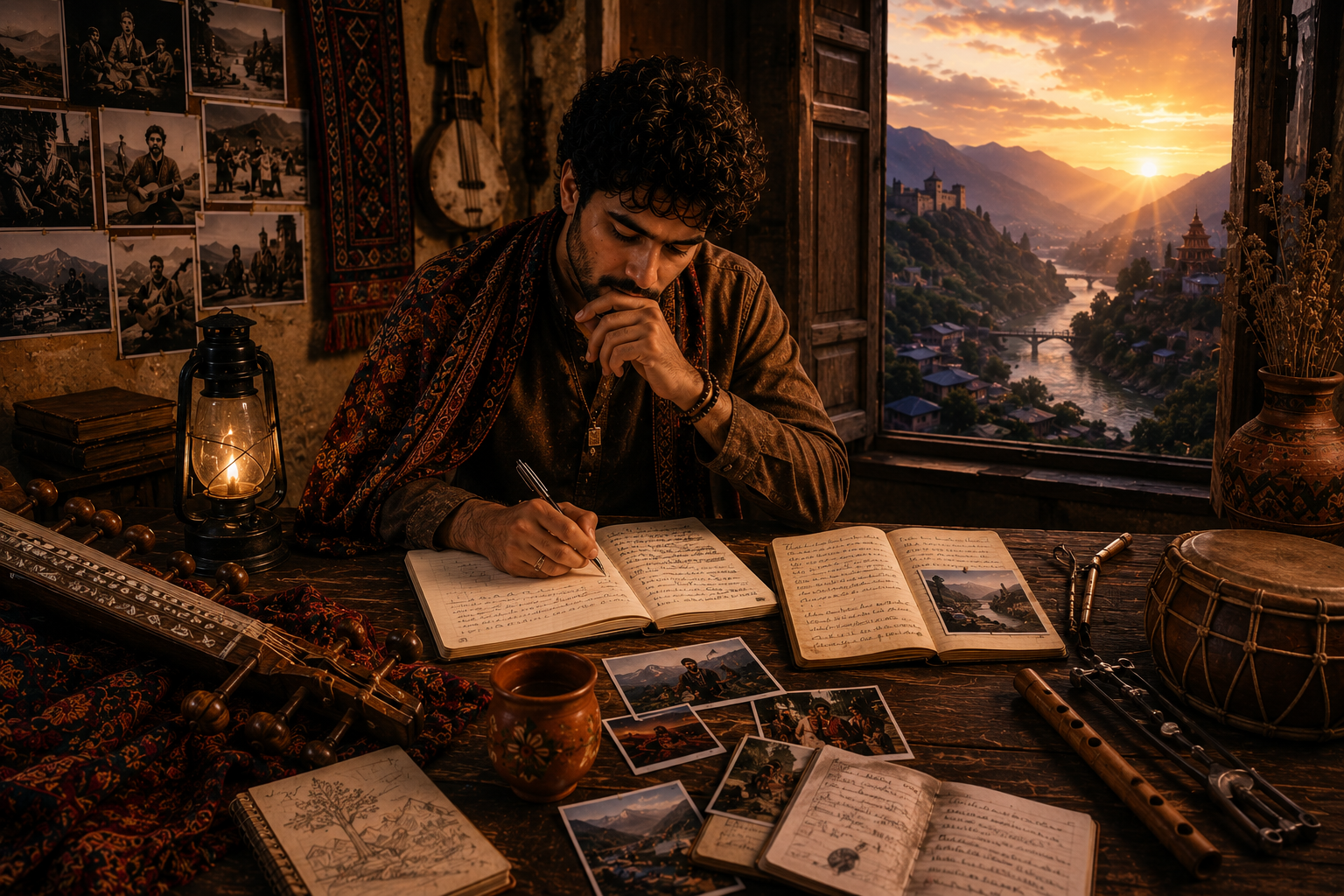
- Document before you compose. Keep a notebook — physical or digital — for observations, images, overheard conversations, memories, and ideas. The raw material of great songs is gathered in ordinary moments, not in front of a microphone.
- Study your tradition deeply. The folk songs of your region contain some of the most sophisticated storytelling in existence. Listen to them not just as music but as narrative art — notice how they use image, metaphor, and structural repetition to create emotional impact.
- Write honestly about what you actually know. The songs that will define your career are not about imaginary situations or borrowed experiences. They are about the specific texture of your actual life — the places you have lived, the people you have loved, the contradictions you carry.
- Revise ruthlessly. First drafts are about getting the story out. Second and third drafts are about making every word earn its place. A song is not finished when you can't add anything more — it is finished when you can't take anything away.
The regional music scene in J&K is producing artists right now who understand all of this instinctively — who are telling stories that feel specific and true and rooted, and who are finding audiences far beyond their immediate community because of it, not in spite of it. That is the promise of authentic storytelling: the more genuinely yourself you are, the more universally you connect.