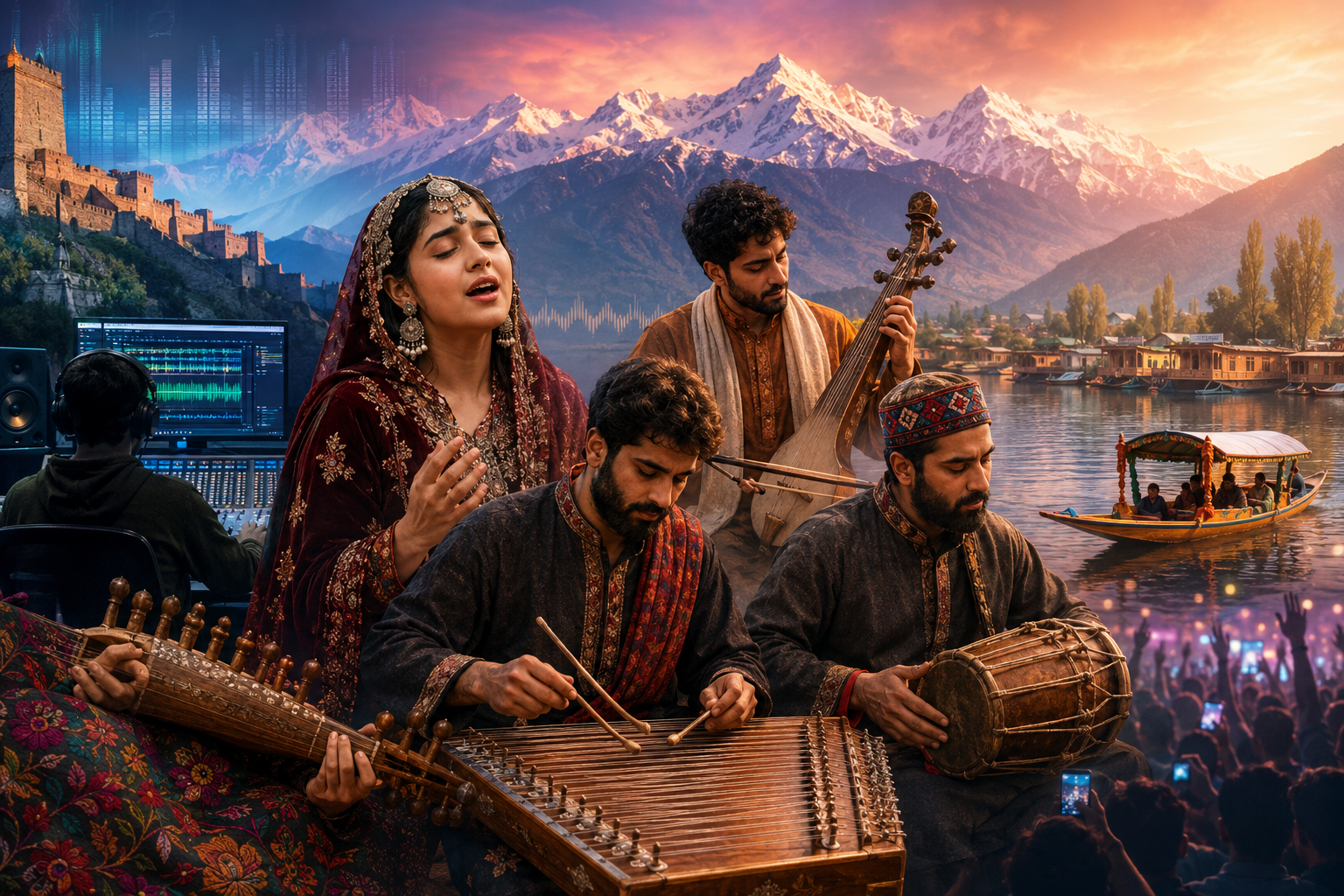
Regional music is having a cultural moment in India. As listeners grow tired of homogenized sounds, artists from smaller regions are finding massive audiences by offering something real, rooted, and deeply human. At the forefront of this movement are the languages and folk traditions of Jammu & Kashmir — particularly Dogri and Kashmiri — two musical heritages that are finally getting the mainstream attention they have always deserved.
This is not a fleeting trend. It is a structural shift in how India listens to music — and understanding it is essential for any artist, label, or industry professional who wants to stay relevant in the decade ahead.
The Streaming Revolution Changed Everything
For decades, the Indian music industry was gatekeeper-driven. Getting your music heard required signing with a major label, securing radio airplay, or landing your song on a Bollywood film. If you were a Dogri folk singer from Jammu or a traditional Kashmiri musician, your audience was largely limited to your immediate community — no matter how talented you were.
Streaming changed all of that. Platforms like Spotify, JioSaavn, Gaana, and YouTube removed the geographic and commercial barriers that kept regional music confined to its home territory. A Dogri song recorded in a studio in Jammu can now reach a listener in Mumbai, London, or New York within hours of its release. The audience has expanded beyond anything previous generations of regional artists could have imagined.
"When I released my first Dogri track, I expected maybe a few thousand local listeners. Within a month, I had fans from places I had never even visited writing to me about how the song reminded them of their grandparents." — A YMA Music artist
Why Dogri and Kashmiri Specifically?
There are hundreds of regional languages and dialects across India, each with rich musical traditions. So what makes Dogri and Kashmiri particularly compelling to contemporary listeners?
Emotional Authenticity
Both Dogri and Kashmiri music are rooted in traditions of deep emotional expression. Kashmiri Sufiyana Kalam, for instance, is one of the oldest surviving classical music traditions in South Asia — a system of devotional music that combines poetic depth with haunting melodic structures. Dogri folk songs, meanwhile, capture the landscapes, seasons, and emotions of the Shivalik and Himalayan foothills with a warmth and directness that feels uniquely personal.
In an era when global pop music often feels manufactured and emotionally hollow, this authenticity is a powerful differentiator. Listeners are actively seeking music that feels honest, and regional music from J&K delivers that in abundance.
Sonic Distinctiveness
The musical scales, rhythmic patterns, and instrumental timbres of Dogri and Kashmiri music are unlike anything else in the mainstream. The santoor, the rabab, the tumbaknari, the bhand — these instruments carry a sonic identity that is immediately recognizable and impossible to replicate with standard studio production. For listeners who have grown up on guitar-bass-drums arrangements, this distinctiveness is genuinely exciting.
Cultural Curiosity
The social and political significance of Jammu & Kashmir has kept the region in the national and international consciousness for decades. But most outsiders know very little about its culture beyond the headlines. Music is the most accessible entry point into a culture, and as curiosity about J&K grows, so does interest in its music.
The New Generation of Regional Artists
What makes the current moment particularly exciting is the emergence of a new generation of artists who are fluent in both their traditional musical heritage and contemporary production techniques. These artists are not simply preserving old forms — they are innovating, fusing, and reimagining them for modern audiences.
A Dogri folk melody layered over a trap beat. Kashmiri poetry set to cinematic production. Traditional call-and-response structures adapted for pop song formats. These fusions are not gimmicks — they are genuine artistic explorations that are producing some of the most interesting music coming out of India right now.
This is exactly the kind of work YMA Music exists to support. Our mission has always been to provide the infrastructure — studios, production expertise, distribution channels, promotional resources — that allows talented regional artists to reach their full potential without compromising their artistic identity.
What the Data Says
The commercial reality is beginning to match the cultural narrative. Regional language streams on major platforms have grown significantly year-over-year. Dogri and Kashmiri tracks are appearing on curated playlists that would have been unimaginable for regional language content just five years ago. Independent artists from J&K are accumulating millions of streams without any major label backing.
Labels and playlist curators are noticing. The infrastructure that once required major label resources — distribution, playlist pitching, promotional campaigns — is now accessible to independent artists and small labels. This democratization of the industry is what makes the current moment so significant.
What This Means for Artists
If you are a Dogri or Kashmiri artist reading this, the message is simple: the opportunity in front of you is real, and it is bigger than at any point in history. But opportunity without strategy rarely converts into success. Here is what the most successful regional artists are doing right now:
- Investing in professional production. The gap between a great song and a viral one is often production quality. Listeners will forgive lo-fi aesthetics in some genres, but not in music that asks them to engage emotionally.
- Building a consistent online presence. YouTube, Instagram, and short-form video platforms are the primary discovery channels for new music. Artists who post consistently and authentically build audiences far faster than those who only appear when they have something to release.
- Telling the story behind the music. The cultural context of Dogri and Kashmiri music is itself compelling content. Sharing the history of a traditional instrument, explaining the meaning of a folk lyric, or documenting the recording process creates additional touchpoints that deepen audience connection.
- Collaborating strategically. Cross-regional collaborations — a Dogri artist working with a Punjabi producer, or a Kashmiri vocalist featuring on a Hindi track — can dramatically expand reach while preserving artistic authenticity.
The Bigger Picture
The rise of regional music in India is part of a global pattern. Across the world, listeners are turning away from the homogenized pop that dominated the streaming era's early years. K-pop, Afrobeats, Latin urbano, cumbia — the genres that have broken through in the last decade have all succeeded by being unapologetically specific about their cultural identity rather than diluting it for mass appeal.
Dogri and Kashmiri music have everything they need to follow that trajectory: deep cultural roots, sonic distinctiveness, a passionate diaspora community, and a growing domestic audience hungry for authentic alternatives to mainstream pop. What was needed was infrastructure — labels, studios, producers, and promoters willing to invest in the long-term development of regional talent.
That is exactly what YMA Music is building in Jammu. And if the momentum of the past two years is any indication, the sounds coming out of J&K are only going to get louder.