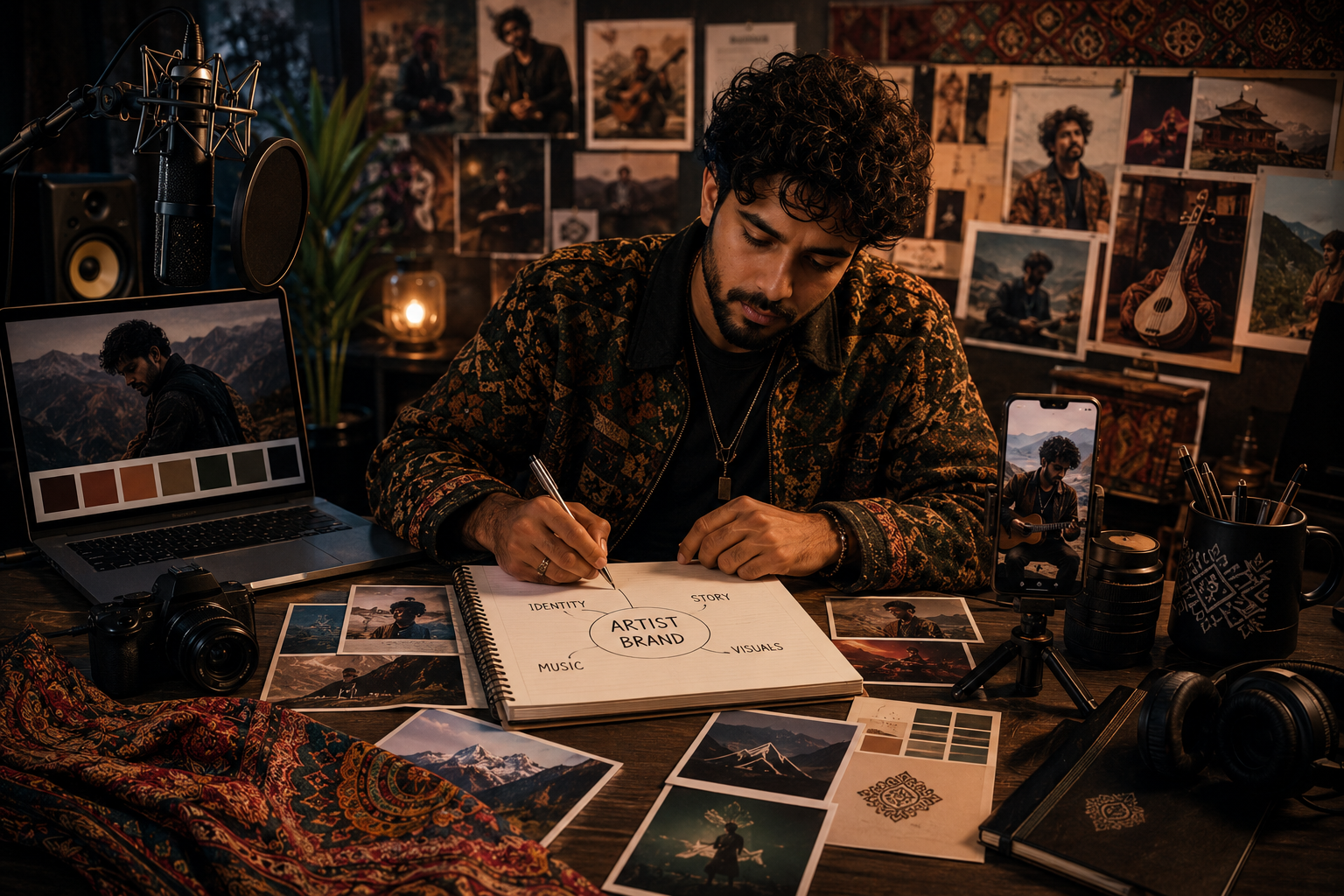
Every day, over 100,000 new songs are uploaded to streaming platforms worldwide. That number is not a typo. In this environment, talent alone is no longer a differentiator — it is a baseline requirement. What separates the artists who build lasting careers from those who disappear after one or two releases is not always musical ability. More often, it is brand.
Personal branding for musicians is not about being fake or corporate. It is about being intentional — deciding how you want to be perceived, what you stand for, and how every touchpoint with your audience reinforces that identity. Done well, a strong personal brand makes everything easier: people find you, remember you, and return to you.
What Personal Branding Actually Means for a Musician
When most artists hear "personal branding," they think of logos, colour palettes, and Instagram aesthetics. Those things matter, but they are the surface layer. Genuine artist branding goes much deeper.
Your brand is the answer to the question: Why should someone care about you specifically? It is the combination of your music, your story, your values, your visual identity, and the way you communicate with your audience. Every single piece of content you release — every photo, video, interview, social post, and live performance — either reinforces or erodes your brand.
The Three Pillars of Artist Branding
1. Identity: Who are you as an artist? What do you represent? For regional artists, identity is often rooted in geography, language, and cultural heritage — and this is a powerful foundation. Your specific relationship to Dogri, Kashmiri, or Pahari culture is something no other artist in the world can replicate. That uniqueness is your brand's strongest asset.
2. Consistency: Brands are built through repetition. The more consistently you show up — in your aesthetic, your messaging, your values, your sound — the faster your audience develops a clear mental image of who you are. Inconsistency creates confusion, and confused audiences do not become loyal fans.
3. Story: People do not connect with products; they connect with stories. What brought you to music? What obstacles have you overcome? What do you want to say with your art? The narrative around your music is often more compelling than the music itself — and it gives journalists, playlist curators, and fans something to hold onto and share.
The Practical Side: Building Your Brand
Define Your Sound and Stick to It (For Now)
Artistic evolution is healthy and inevitable over a long career. But in the early stages, consistency of sound helps audiences know what to expect from you. If you release a folk-influenced Dogri ballad followed by a hip-hop track followed by an EDM remix, casual listeners will not know how to categorise you — and categorisation is how music gets recommended and shared.
This does not mean you cannot experiment. It means that your core output should have a recognizable sonic identity that listeners can anchor themselves to.
Own Your Visual World
Before someone presses play on your song, they see your artwork, your profile image, or your social media feed. These visual first impressions matter enormously. Invest time in developing a visual language for your artist persona — colours, fonts, photography style, video aesthetics — that is distinctly yours and reflects the emotion of your music.
"Your visual identity is the packaging. Your music is the product. Both need to be great — but it is the packaging that gets someone to pick it up in the first place."
Be Strategic About Social Media
You do not need to be everywhere. You need to be excellent in the places where your audience actually spends time. For most regional artists in India right now, that means Instagram Reels and YouTube Shorts for discovery, and longer YouTube content for depth. Pick your platforms, understand their algorithms, and commit to a consistent posting rhythm.
The artists who grow fastest are not the ones who post the most — they are the ones who post the most consistently and with the most authentic purpose.
Develop a Press Narrative
At some point, journalists, bloggers, and curators will write about you. Make it easy for them. A well-crafted artist biography — one that tells your story compellingly, highlights your unique background, and communicates your artistic vision — is an underrated but essential branding tool. The narrative you control is always better than the narrative others invent for you.
Common Branding Mistakes to Avoid
- Trying to appeal to everyone. The more specific your brand, the stronger it is. "I make music for everyone" is not a brand position — it is the absence of one.
- Copying successful artists. Inspiration is fine; imitation is a dead end. Audiences can sense inauthenticity, and a brand built on copying someone else will always feel hollow.
- Neglecting the non-musical content. The artists with the strongest brands share their lives, their process, their failures, and their passions — not just their releases. People follow people, not just music catalogues.
- Letting branding override artistry. The brand exists to serve the music, not the other way around. If you spend more time thinking about your aesthetic than your songs, your priorities are inverted.
Regional Identity as Brand Superpower
For artists from Jammu & Kashmir, cultural identity is not just a branding element — it is a competitive advantage. In a market flooded with artists trying to sound global and universal, the specifically local stands out. Your language, your landscapes, your festivals, your folk traditions — these are branding assets that cannot be manufactured by any competitor.
Lean into them. Celebrate them. Build a brand that makes your audience feel like they have discovered something rare and authentic — because they have.
The artists who will define the next chapter of regional music in India will be those who are as intentional about their brand as they are passionate about their craft. At YMA Music, we work with every artist we sign to develop a brand identity that is as compelling as their music — because in today's landscape, you need both.