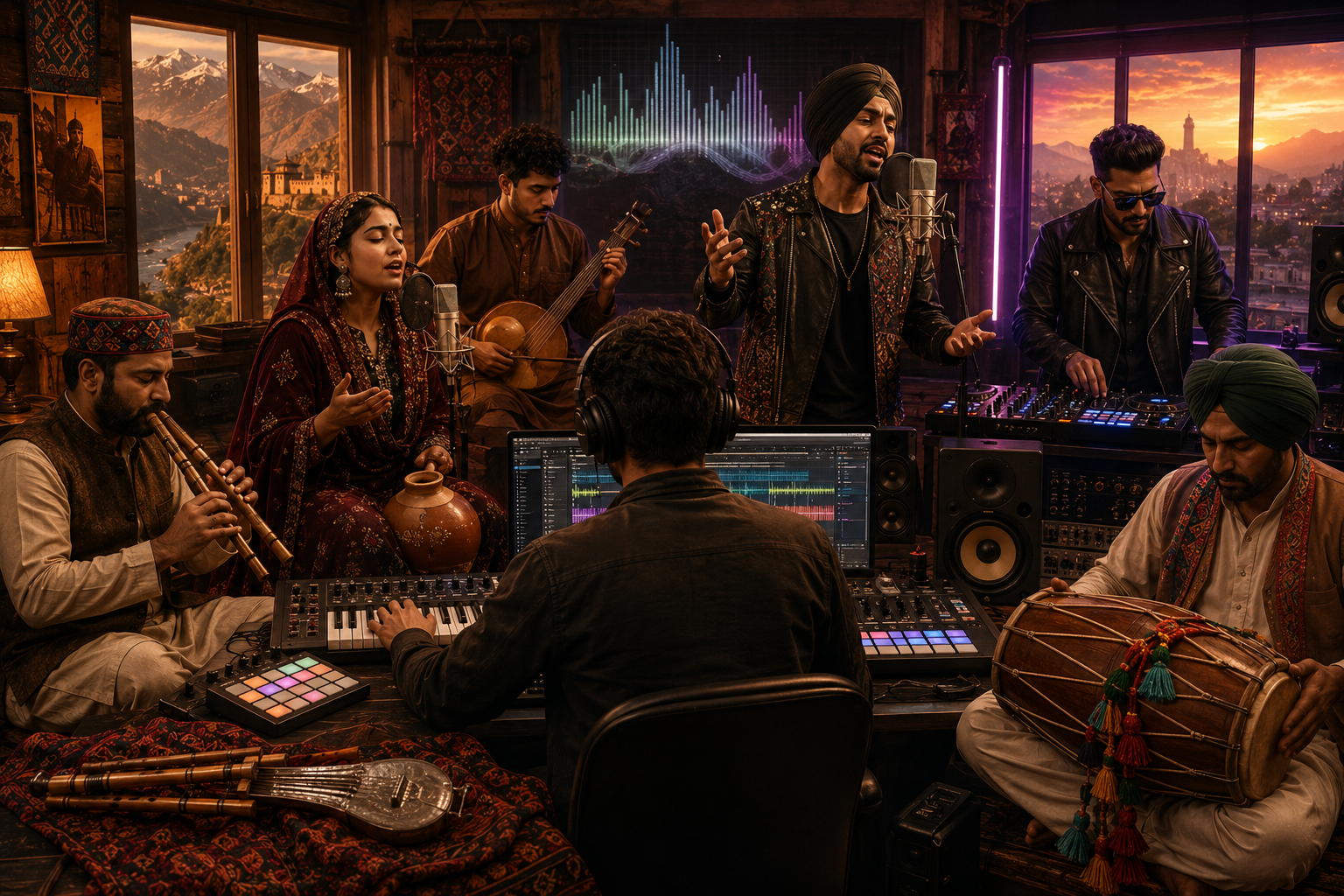
What happens when ancient Dogri folk rhythms meet contemporary Punjabi production? The answer is some of the most exciting music coming out of North India right now — a sound that is simultaneously ancient and modern, rooted and restless, local and universal.
The Punjabi-Dogri musical corridor is not a new phenomenon. The two cultures have shared borders, trade routes, and family connections for centuries. The folk traditions of the Shivalik foothills and the plains of Punjab have always influenced each other. What is new is the speed and scale at which that exchange is now happening — accelerated by digital distribution, social media, and a new generation of producers who are fluent in both traditions.
Understanding the Two Traditions
Dogri Folk Music: Mountains and Memory
Dogri folk music is inseparable from the landscape that produced it. The Shivalik hills, the Tawi river, the seasonal rhythms of agricultural life, the festivals of Baisakhi and Lohri — these are the raw materials from which Dogri songs are made. The music tends toward the meditative and lyrical, with a melodic sensibility that reflects the contemplative quality of mountain life.
Traditional Dogri instruments — the tumbaknari (a small clay pot drum), the chimta (tongs), the algoza (a twin flute) — carry a sonic texture that is unmistakably of this region. The call-and-response vocal structures of Dogri folk are particularly distinctive, creating a communal, participatory energy that is difficult to replicate in studio production.
Punjabi Music: Energy and Innovation
Punjabi music needs little introduction. From the bhangra explosion of the 1990s to the global dominance of Punjabi pop in the streaming era, Punjab has been the engine room of North Indian popular music for three decades. What makes Punjabi music so globally adaptable is its rhythmic vitality — the dhol beat, the punchy bass lines, the irresistibly danceable energy that transfers across language barriers with ease.
Contemporary Punjabi producers have also developed extraordinary technical sophistication, incorporating Western electronic production, trap beats, and global pop structures while maintaining a distinctly Punjabi character. This technical infrastructure is now available to Dogri artists in ways that were unimaginable a decade ago.
How the Fusion Is Happening
The Punjabi-Dogri fusion happening right now is not a single style or movement — it is a spectrum of approaches, each representing a different way of navigating between the two traditions.
Folk Melodies Over Modern Production
The most straightforward approach takes a traditional Dogri folk melody — often drawn from seasonal songs, wedding music, or devotional traditions — and produces it using contemporary Punjabi production techniques. Modern drum programming, synthesised bass, layered harmonics, and professional mixing give the folk source material a sonic quality that works on streaming platforms while preserving the melodic and lyrical essence of the original.
This approach is accessible to producers who may not be deeply trained in Dogri tradition but can recognise and honour a melody. The risk is superficiality — using folk elements as exotic decoration rather than as the genuine core of the music. The best artists in this space go deep into the tradition before they start producing.
Language Mixing and Code-Switching
Another increasingly common approach is deliberate linguistic mixing — songs that move between Dogri and Punjabi (or Hindi) within the same track, sometimes within the same verse. This code-switching reflects the linguistic reality of everyday life in the Jammu region, where most residents are naturally multi-lingual and move fluidly between languages depending on context.
Songs that embrace this linguistic fluidity often find audiences in both the Dogri-speaking community and the broader Punjabi music market simultaneously. They communicate authenticity to local listeners while remaining accessible to a wider audience.
Rhythmic Cross-Pollination
Perhaps the most sophisticated fusion approach involves merging the rhythmic systems of the two traditions. The tumbaknari patterns of Dogri folk music are metrically complex in ways that differ significantly from dhol-based Punjabi rhythms. When a producer deeply understands both systems, the combinations can be genuinely surprising and musically rich — creating grooves that feel familiar enough to dance to but distinctive enough to stop a listener in their tracks.
"The best fusion music doesn't choose between its influences — it finds the place where both are simultaneously true. That's where the interesting things live."
The Digital Accelerant
None of this fusion would be happening at the scale it is without digital infrastructure. Three specific developments have been transformative:
Affordable professional production tools. Digital audio workstations, virtual instruments, and high-quality microphones are now accessible at price points that were unimaginable fifteen years ago. A talented producer in Jammu can now achieve production quality that rivals major city studios. This has removed the geographic disadvantage that previously made it difficult for regional artists to compete.
YouTube as a musical archive. The digitisation and uploading of traditional Dogri folk recordings — many of them decades old — has given a new generation of producers and artists access to source material that was previously confined to cassette tapes in family collections. This living archive is both a creative resource and a cultural preservation project.
Social media discovery. Short-form video platforms have created a new discovery mechanism that bypasses traditional gatekeepers. A Dogri-Punjabi fusion track that connects emotionally can go from zero to a million views without any label support or radio airplay. The algorithmic discovery system rewards novelty and authenticity — two qualities that genuine fusion music has in abundance.
Challenges and Tensions
Not everyone is celebrating the fusion movement. Purists in both traditions express concern about what is lost in the blending — the specific cultural meaning of folk forms, the linguistic precision of traditional lyrics, the communal contexts in which folk music was originally intended to be performed.
These concerns are legitimate and worth taking seriously. The best practitioners of Punjabi-Dogri fusion are acutely aware of them. The distinction between cultural fusion and cultural dilution is real, and it requires genuine knowledge and respect to navigate well. An artist who uses Dogri folk elements superficially — as a marketing differentiator rather than a sincere cultural expression — is doing something fundamentally different from an artist who has grown up with these traditions and is finding their own contemporary voice within them.
The test is always: does the artist understand what they are working with, and do they treat it with the seriousness it deserves?
What Comes Next
The Punjabi-Dogri fusion movement is still in its early stages. As more producers and artists from both traditions develop the technical skills and cultural knowledge to work across the divide, the music will only become more sophisticated and more interesting.
There is also potential for expansion beyond the Punjabi axis — fusions that bring Dogri and Kashmiri traditions into dialogue with each other, or that connect J&K's musical heritage with traditions from other parts of India. The regional music map of India is extraordinarily rich, and the digital infrastructure now exists to explore it in ways that were previously impossible.
At YMA Music, we are actively supporting artists who are working at the intersection of these traditions. Our production team has deep roots in both Dogri folk music and contemporary North Indian production — which means we can help artists navigate the creative and technical challenges of fusion work without losing what makes their music genuinely their own.